





One of the biggest parts of planning any trip for me happens long before we ever get to the airport.
As someone living with Type 1 diabetes, I can’t exactly throw a few outfits into a suitcase and call it a day. There are Omnipods, Dexcom sensors, insulin, low blood sugar treatments, backup supplies, chargers, and all of the little things I use every day without really thinking about them.
For our upcoming trip to Italy, we’ll be gone for a total of nine days, and because we’ll be traveling internationally, I’m taking my usual diabetes preparation a few steps further.
My philosophy for this trip is pretty simple: I would rather bring way too much and bring it all home unused than find myself across the ocean wishing I had packed one more diabetes supply.
Here’s what I’m planning to bring.
Omnipods: Definitely More Than I Should Need
I use the Omnipod 5 insulin pump, so pods are obviously at the top of my packing list.
Technically, if every pod lasted the full three days and absolutely nothing went wrong, I could pack just three pods for our nine-day trip.
There is absolutely no way I’m flying all the way to Italy with only three pods. Instead, I’m packing 12 Omnipods.
That gives me essentially one pod for every day of our trip, plus a few additional backups.
Will I use all 12? Hopefully not!
But pods can fail, leak, get knocked off, or need to be changed sooner than expected. I would much rather fly home with a stack of unopened pods than find myself in another country trying to figure out how to replace one.
International travel is one of those situations where I’m perfectly okay with over-packing.
Dexcom Sensors
The same idea applies to my Dexcom.
The sensor I plan to be wearing when we leave should technically last until September 8, and because my Dexcom sensors last 15 days, I shouldn’t even need to change it while we’re in Italy.
I’m still packing two backup sensors.
A sensor can fail early, accidentally get pulled off, have adhesive problems, or simply decide that vacation is the perfect time to stop cooperating.
There is a very good chance both of those sensors will make the entire round trip without ever being opened — and that’s exactly what I’m hoping for.
But if something does happen, I’ll have replacements with me.
Pump Peelz, Sensor Covers, and the Italian Heat
Before our trip, I also need to place an order for more sensor covers from Pump Peelz.
I used to use Skin Grip patches, and they worked well for keeping my devices secure, but lately I’ve really been loving Pump Peelz because of all of their decorative options.
If I have to wear a Dexcom every single day anyway, I might as well make it cute — especially for Italy!
For this trip, though, the sensor cover isn’t just about decoration.
The weather while we’re in Italy is expected to be similar to a Charleston summer — hot, with temperatures potentially above 90°F.
Between the heat, sweating, walking for hours, sightseeing, and being outside most of the day, I want to give my Dexcom adhesive a little extra help.
I plan to keep a sensor cover over my Dexcom throughout the trip as an extra precaution to hopefully keep it from peeling or falling off early.
I’ll also pack several extra covers in my diabetes backpack. If one starts peeling or I unexpectedly have to replace my Dexcom, I’ll already have another one ready to go.
Hopefully, between my sensor covers and my two backup Dexcom sensors, my CGM stays exactly where it belongs while we explore Italy.
Insulin — Plus More Backup Than Usual
For our Italy trip, I’ll be traveling with three vials of Humalog insulin total:
- The open vial I’m already using
- Two unopened backup vials
Normally when I travel, I bring one extra vial of insulin. For this trip, I’m bringing two.
I would hate to find myself in a situation where something happens to my open vial, I open my backup vial, and then discover that something is wrong with that one too.
Could three vials be excessive for a nine-day trip? Absolutely.
But insulin is not something I’m willing to take a chance on.
My unopened insulin will be kept in a cooling pack while we travel so it stays protected from the heat. I’ll also make sure the insulin doesn’t sit directly against anything frozen because I’m trying to protect it from both excessive heat and freezing temperatures.
Can I Buy Insulin in Italy?
I also have a little diabetes-related mission for this trip: I want to see if I can purchase insulin at a pharmacy in Italy.
I saw another diabetic share her experience of traveling to Italy and being able to purchase insulin after showing the pharmacist a copy of her prescription.
That immediately made me curious.
I plan to bring a copy of my Humalog prescription with me and stop by a pharmacy while we’re there to see what the process is actually like.
I want to be very clear, though: I am not depending on being able to purchase insulin in Italy.
That’s exactly why I’m bringing plenty of insulin from home.
If I’m able to purchase it, I’d love to document the entire experience — what the pharmacist asked for, whether they carried my exact insulin, how much it cost, and how easy or difficult the process was.
My Backup Insulin Plan
Packing extra Omnipods isn’t my only backup plan.
I also want to be prepared for the possibility that, for whatever reason, I can’t use my insulin pump at all.
Before we leave, I plan to have my endocrinologist update my prescription for Lantus, my long-acting insulin, so I can bring a current Lantus pen with me.
My backup supplies will also include:
- Syringes so I can inject Humalog directly from my insulin vial
- Pen needles for my Lantus pen
- My extra Omnipod handheld controller
- A copy of my pump settings
I normally control my Omnipod directly from my phone, but I’ll be packing the separate Omnipod handheld device just in case something happens to my phone, or I’m unable to use it.
I’m also going to have my basal settings written down in a note on my phone, along with Steven’s settings.
That way, if either of us ever has to switch away from our normal pump setup unexpectedly, we aren’t trying to remember important information while dealing with an already stressful situation.
For me, traveling with Type 1 diabetes means thinking beyond: “What happens if my pod fails?”
I also want to know: “What happens if I can’t use my pump at all?”
Hopefully, the Lantus, syringes, pen needles, extra controller, and written settings never leave my medical bag.
But having them there gives me peace of mind.
Low Blood Sugar Treatments
I’ll also be packing plenty of my usual low blood sugar treatments.
Some of my go-to options are coming to Italy with us, including:
- Glucose tablets
- Welch’s Fruit Snacks
- Capri Sun pouches
While we’re out exploring Italy, I’ll keep a handful of these in my backpack at all times.
I never want to be in a situation where my blood sugar is dropping, and I have to find somewhere to buy something before I can treat it.
Having fast-acting carbohydrates that I already know work well for me means I’ll always have a reliable option within reach.
But I’m also planning to have a little fun with it.
If my blood sugar is low and the situation allows, I fully intend to use the opportunity to try some of the local Italian sweets along the way.
Pastries? Candy? Gelato?
I’m sure Italy will give me plenty of options.
If I’m dropping quickly or need a predictable amount of carbohydrates, I’m reaching for the glucose tablets, fruit snacks, or juice that I know.
But for those slower, manageable lows?
When in Italy… why not treat a low with something Italian?
Two Battery Packs Are Coming With Us
Any time Steven and I travel, we always have an external battery pack with us.
For Italy, we’re taking that one step further: We’re bringing two.
We already know we’re going to use our phones a lot during this trip. Between taking photos and videos, navigating, looking up reservations, and documenting our adventures, our batteries are probably going to get a workout.
But for me, keeping my phone charged is about more than being able to take another picture.
My phone is also what I use to control my Omnipod.
Because of that, a dead phone could become much more than an inconvenience.
Our plan is to carry both battery packs with us and make charging them part of our nightly routine.
Every night when we get back to our hotel, the phones and battery packs are getting plugged in so we can start the next morning with everything fully charged.
I’ll still have my separate Omnipod handheld controller as another backup, but keeping my phone powered throughout the day will definitely be a priority.
At this point, a portable battery pack has become just as much a part of my diabetes travel supplies as glucose tablets and extra pods.
Everything Is Going in My Medical Backpack
All of these supplies will be packed together in a dedicated medical backpack, and that backpack will be coming onto the airplane with me.
My essential diabetes supplies will not be going into our checked luggage.
If our checked luggage decides to take a different vacation than we do, we can replace clothes. We can replace toiletries.
Replacing my insulin, Omnipods, Dexcom sensors, and other diabetes supplies in another country would be a completely different situation.
Fun Fact: Your Medical Supplies May Not Count Toward Your Normal Carry-On Allowance
Something travelers with medical conditions may not realize is that medically necessary supplies and assistive devices generally do not count toward the normal carry-on baggage allowance when flying from the United States.
That’s another reason I plan to keep my medical backpack dedicated to my diabetes and medical supplies instead of filling it with regular travel items.
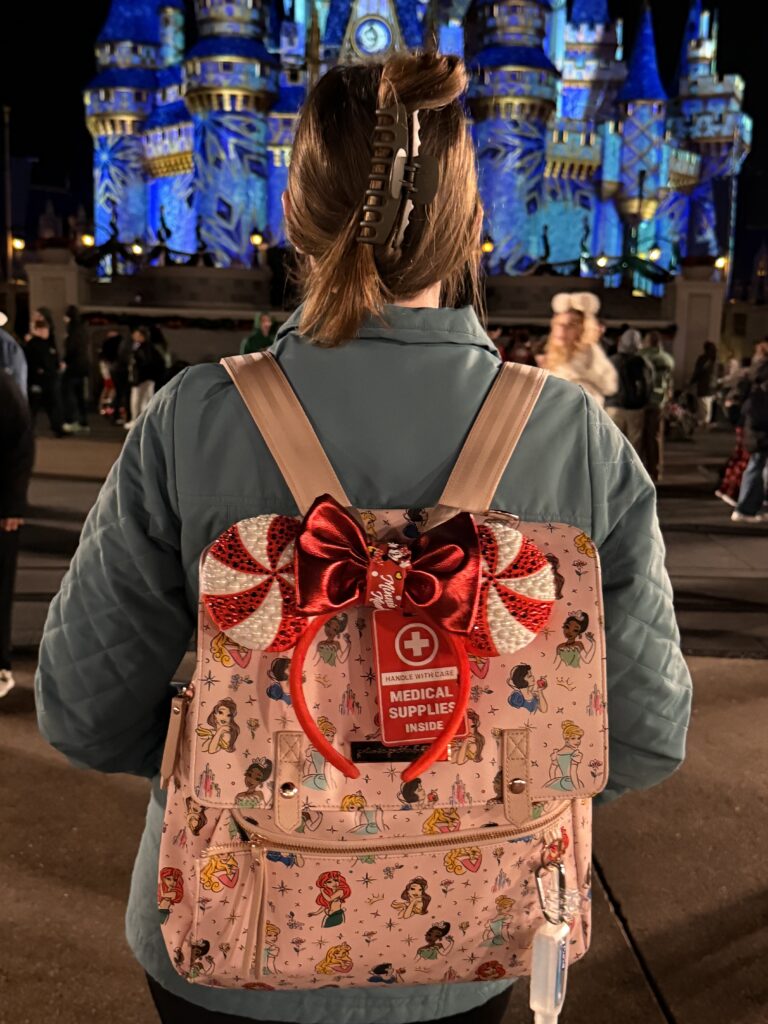
I’ll also have a medical bag tag attached to the backpack so it is clearly identifiable.
Before traveling, I always think it’s a good idea to check your individual airline’s policy, especially for international flights.
Helpful official resources include:
- U.S. Department of Transportation — Airline Passengers with Disabilities Bill of Rights
https://www.transportation.gov/airconsumer/disabilitybillofrights - U.S. Department of Transportation — General Travel Tips for Persons with Disabilities
https://www.transportation.gov/individuals/aviation-consumer-protection/general-travel-tips-persons-disabilities - TSA — Insulin Supplies
https://www.tsa.gov/travel/security-screening/whatcanibring/items/insulin-supplies - TSA — Insulin Pumps and Glucose Monitors
https://www.tsa.gov/travel/security-screening/whatcanibring/items/insulin-pumps-and-glucose-monitors
A quick note about the bag pictured: This is my normal Disney park bag, and I use it in the parks every trip. I also used it when we traveled to New York last fall because it was an easy way to keep all of my diabetes supplies with me throughout the day.
For Italy, though, I’ll be using a more discreet backpack. Since we’ll be traveling internationally and spending a lot of time in busy tourist areas, I want something a little less noticeable while still keeping all of my medical supplies with me wherever we go.
My medical backpack won’t just stay with me on the plane, either. It will be coming everywhere with us in Italy.
Whether we’re sightseeing, walking around a city, eating dinner, or spending an entire day away from the hotel, my diabetes bag will be right there with us.
I’ll have insulin, low treatments, backup pump supplies, and the things I would need if something unexpected happened.
Yes, that means carrying an extra backpack around Italy.
I’m perfectly okay with that.
Packing for the “What Ifs”
When you look at everything I’m bringing for nine days, it probably sounds like a lot.
Twelve Omnipods.
Two backup Dexcom sensors.
Three vials of insulin.
Long-acting insulin.
Syringes.
Pen needles.
Low treatments.
Sensor covers.
A backup Omnipod controller.
Two battery packs.
And plenty of other little diabetes supplies tucked into my medical bag.
Hopefully, I’ll come home with almost all of it unused.
That would actually mean my packing plan worked perfectly.
I don’t pack based only on what I should need if everything goes exactly according to plan.
I pack for the pod that fails.
The sensor that gets pulled off.
The vial that gets too hot.
The delayed flight.
The low blood sugar in the middle of sightseeing.
The phone battery that suddenly drops to 10%.
And all of those other little “what ifs” that come with traveling with Type 1 diabetes.
Because the goal isn’t to spend nine days in Italy worrying about diabetes.
The goal is to do as much preparation as I can before we leave so that once we get there, Steven and I can focus on experiencing Italy, taking way too many pictures, eating incredible food, and making memories together.
And maybe occasionally treating a low blood sugar with some Italian gelato.
Free Diabetes Travel Packing Checklist
If you’re getting ready for a trip of your own, I created a reusable Diabetes Travel Packing Checklist to help keep everything organized.
It includes spaces to write how many days you’ll be traveling, calculate how many supplies you need, check off each item as you pack, and keep track of anything you still need to order before your trip.
I originally made it to help organize my own diabetes supplies, but I wanted to share it here in case it makes packing a little easier for someone else too.
**This checklist reflects the supplies I personally consider when traveling with Type 1 diabetes. Always pack according to your own diabetes management plan and healthcare provider’s recommendations.**
Travel Gear I Use
- Insulin cooling bag: http://amazon.com/dp/B004X4J5ZK?ref_=ppx_hzsearch_conn_dt_b_fed_asin_title_2
- Medical backpack: This is the same style of bag I use for my diabetes supplies, but my Disney princess print is no longer available. The bag is still available in other patterns. https://petunia.com/collections/meta-diaper-bag-backpacks/products/meta-backpack-in-black-matte-canvas
- Medical supplies bag tag: The exact tag I use is currently unavailable on Amazon, but I still wanted to include it because it’s part of my usual travel setup. I’ll update this link if it becomes available again. https://www.amazon.com/dp/B0DZ5K2RHK?ref_=ppx_hzsearch_conn_dt_b_fed_asin_title_3
- External battery pack: https://www.amazon.com/INIU-Portable-High-Speed-Flashlight-Compatible/dp/B0CB1FW5FC/ref=sr_1_3?crid=3KJTWNMZ0K5TN&dib=eyJ2IjoiMSJ9.4VDhCkOdnOHqPxFZkfGhCfPW6lg9ZjMy7-kPVwlcDmZZYRyvOL7xl2r8aeCUsrbSh891RYHoqtDeeyEElK9h_RAnASijCLFcS-vOBJfJUJ61V60C0KlBlaOk1s-QoCb_4B2fRBr0b6weutflj7DdR12tfgvBCop-57EBZJ7rLQlpIFelAi_4mQ3zNeG8QzK8pH4BDYKw7InOf3T0u65S27hKsqY5PB81g5OaevfroaI.dDWprfpc1pZbVN7w9UefKXxAafdK3R9J_zFMT_0Gof4&dib_tag=se&keywords=external%2Bbattery%2Bpower%2Bbank&qid=1786567693&sprefix=external%2Bbatter%2Caps%2C199&sr=8-3&th=1
- Pump Peelz sensor covers: https://www.pumppeelz.com/
Harriet’s Diabetes Travel Notes
For international travel, my biggest rule is simple:
Bring more diabetes supplies than you think you’ll need, keep your essential supplies with you, and have a backup plan for your backup plan.
For our nine days in Italy, I’m planning for things I hope never happen.
Hopefully, I won’t need 12 Omnipods.
Hopefully, the Lantus never comes out of my medical bag.
Hopefully, both backup Dexcom sensors stay in their boxes.
Hopefully, both backup vials of insulin come home unopened.
But I would much rather carry a little extra weight through Italy than spend part of our trip wishing I had packed something that was sitting at home.
Diabetes is coming to Italy with us.
But with a little extra preparation, I’m hoping it can spend most of the trip quietly riding around in my backpack while we enjoy the adventure.